Showing posts with label space. Show all posts

Monday, March 8, 2010

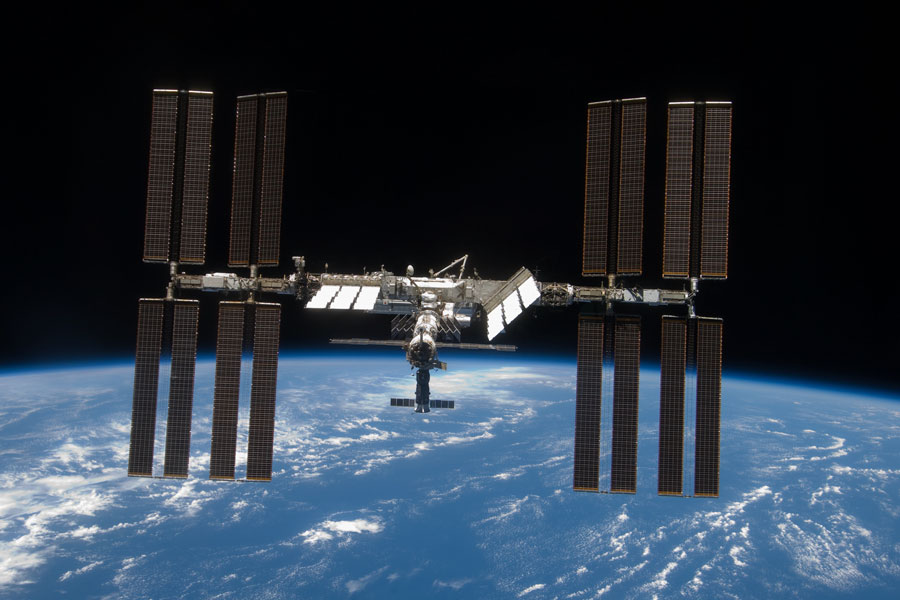
International Space Station wins Collier Trophy 2009


     The International Space Statino has won the Collier Trophy for the year of 2009. This award is pretty much like the Nobel Prize for space and aviation in aviation given to the "greatest achievement in aeronautics or astronautics in America." Given by the National Aeronautic Association, the International Space Station bas been announced as the 2009 winner and the ISS team will be formally presented the award May 13. The station is now nearing completion, which will allow truly unparalleled research and advancement in science. Already, it has made great advancements in areas such as biology, human physiology, and materials science.
      NASA, one of the international agencies working on the project along with the European Space Agency, Russian Federal Space Agency, the Canadian Space Agency, and Japan Aerospace Exploration Agency, plays an important part in the construction of the most complicated spacecraft ever built. "We are honored to receive this prestigious award," said Bill Gerstenmaier, the associate administrator of Space Operations Mission Directorate. The International Space Stationg will reach completion later this year, and will mark the 10th anniversary of continuous human presence in space. Boasting past awardees such as the F-22, Boeing 747, F-117 Nighthawk, and Spaceship One, the Collier Trophy truly represents the pinnacle of human achievement in aeronautics and space, fit for a space station that has marked the continuous progress of international human presence and advancement in space.

http://www.nasa.gov/mission_pages/station/expeditions/expedition22/iss_award_feature.html
http://www.naa.aero/html/awards/index.cfm?cmsid=62

Wednesday, February 3, 2010

Constellation Program Cancelled?

President Obama, in his economic budget plan for 2011, plans to cut the Constellation program of NASA in light of the recent budget plans for reducing the nation's deficit. With the space shuttle set to retire this year, the canceling of the Constellation program, which planned to be the next step in manned spacecraft with the Orion capsule and Ares rocket, means NASA will have to  look to private companies to man their space ventures, not to mention scrap the hopes of returning to the moon by 2020.


Orion Crew Exploration Vehicle

Tuesday, December 22, 2009

Commercial Spaceflight


Virgin Galactic revealed its SpaceshipTwo and VMS Eve, its mothership, on December 7, signifying how far the dream of space tourism has really come. SpaceshipTwo, now named Enterprise, is the first commercial spacecraft, and is expected to begin service in about a year and half. The company and spaceship are the brainchildren of Richard Branson.

Sunday, November 8, 2009

Ion Engines

Ad Astra's Variable Specifc Impulse Magnetoplasma Rocket (VASIMR)
 

It seems that in the long run, space exploration or travel will never work with the speeds we have now. Rocket engines using chemical fuels just don't cut it when it comes to traveling far, going to other planets that would take years to get to. Ion engines are not that new of a concept, the idea's been around since the beginning of the 20th century.

Sunday, October 11, 2009

Space Debris


Have you ever thought about the problem of space debris? Even if some of the debris in orbit eventually burns up in the atmosphere, there must still be a lot out there, orbiting. I'm surprised we don't hear more stories about collisions with debris, seeing as how even a tiny shard or piece of dust could creaste colossal damage at high speeds. There've been some collisions with satellites, and just imagine how many individual shards and debris that creates. If a floating piece of debris hits a vehicle or a bigger piece of debris, this could create even more, leading to a chain reaction effect.

I think this should be a pretty big goal for space agencies or humans in general about space; in about fifty years of space, we've created millions of pieces of space debris, not to mention the natural space dust already out there. We should at least try to figure out a way to reduce the amount or diverting it... Imagine what would happen if more and more crashes occurred in Earth's orbit, and it became virtually impossible to go out into space without getting hit and even furthering the amount of debris...

Friday, August 21, 2009

Airplanes or Spacecraft?

We know that both airplanes and spacecraft have had huge influence on our world; and both are probably some of the most important inventions or developments in our world today. But which are most influential?

Since 1903, airplanes have become something we use so much.. What would life be like if we had to wait weeks to travel to another continent? So much more of our lives would be consumed with transportation, not to mention the implications (or lack of) on warfare. But with spacecraft, we've explored some of the things outside of our world - What influence will it have over our future? When we have to think of settling in other planets or something?

Which one is more influential? Or has the potential to be?